 By WO
By WO 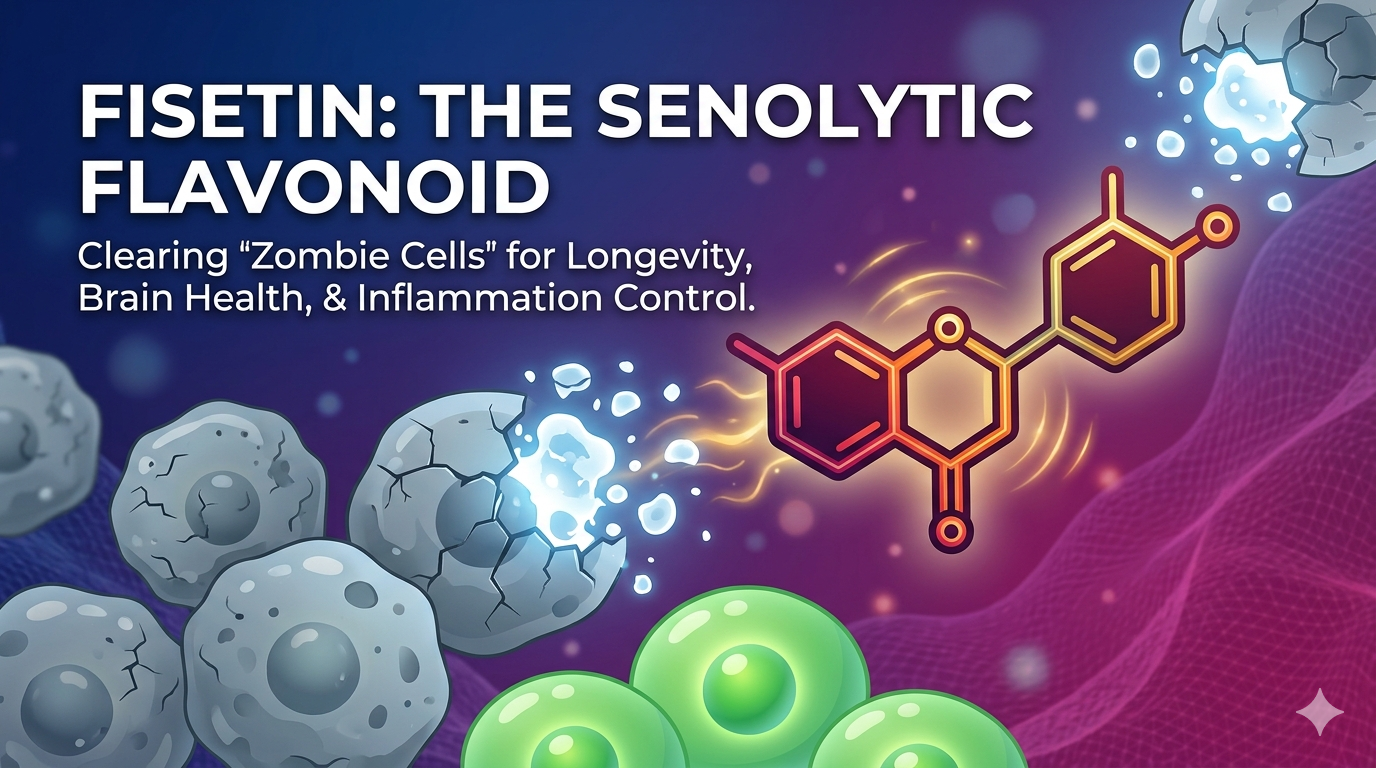
Fisetin: The “Master” Senolytic for Cellular Longevity and Cognitive Resilience
In the rapidly evolving landscape of longevity science, we have moved beyond simple antioxidants. The modern focus is on senolytics—compounds capable of clearing out “zombie cells” that accumulate as we age.
Among these, Fisetin has emerged as perhaps the most potent naturally occurring flavonoid for promoting cellular renewal. While it lacks the mainstream name recognition of Resveratrol or Quercetin, recent comparative studies suggest Fisetin may actually outperform them in its ability to extend health span and protect the aging brain.
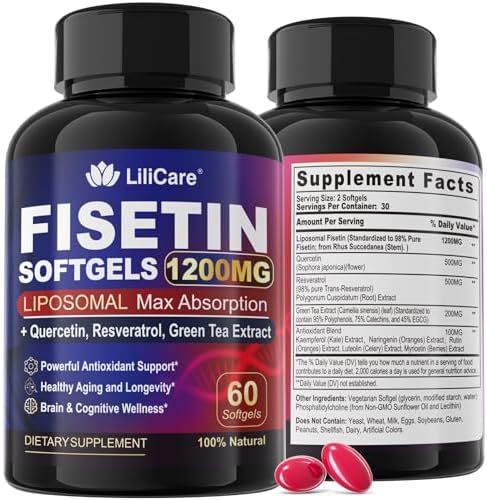
- [Longevity and Age-Defend Support]: Longevity is a common aspiration, and Fisetin is celebrated for its age-defend and l…
- [Powerful Antioxidant & Brain Health Support]: Our liposomal fisetin supplement is crafted for potent brain health and a…
- [Why Choose the Liposomal]: Our Liposomal Fisetin softgel supplement offers 10x superior absorption and bioavailability….
What is Fisetin? The Strawberry-Derived Longevity Molecule
Fisetin is a bioactive flavanols found in various fruits and vegetables, most notably strawberries, apples, persimmons, and onions.
To understand its therapeutic potential, we have to look at the concentration. To reach the dosages used in clinical longevity protocols—typically 1,000mg to 1,500mg—you would need to consume roughly 37 pounds of strawberries in a single sitting. For this reason, those pursuing “biological age reversal” rely on high-purity, often liposomal, Fisetin supplements.
The Senolytic Mechanism: Clearing the “Zombie Cells”
The primary reason Fisetin has captured the attention of the Mayo Clinic and longevity researchers worldwide is its role as a senolytic.
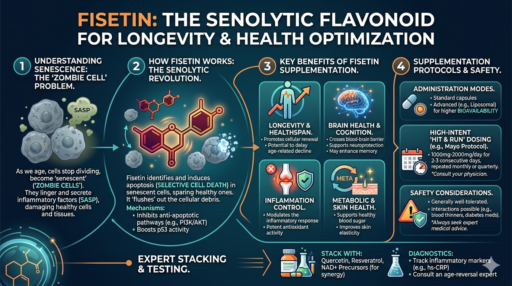
As we age, some cells stop dividing but refuse to die. These are senescent cells, often dubbed “zombie cells.” Instead of being cleared by the immune system, they linger and secrete a toxic cocktail of inflammatory proteins known as the SASP (Senescence-Associated Secretory Phenotype). This SASP “infects” neighboring healthy cells, driving systemic inflammation and tissue breakdown.
How Fisetin intervenes:
- Selective Apoptosis: Fisetin identifies these senescent cells and flips their “self-destruct” switch (apoptosis) while leaving healthy cells untouched.
- SIRT1 Activation: Much like Resveratrol, Fisetin activates sirtuins, the body’s “longevity genes” that repair DNA.
- mTOR Inhibition: By downregulating the mTOR pathway, Fisetin encourages autophagy—the process where cells clean out internal debris.


Fisetin for Brain Health and Neuroprotection
Beyond cellular clearing, Fisetin crosses the blood-brain barrier, making it a formidable tool for cognitive preservation.
- Memory Enhancement: Research indicates that Fisetin facilitates Long-Term Potentiation (LTP), the process by which connections between neurons are strengthened to form memories.
- Reduced Neuroinflammation: By inhibiting inflammatory cytokines in the microglia (the brain’s immune cells), Fisetin may help mitigate the “brain fog” associated with aging and systemic inflammation.
- Protection Against Oxidative Stress: It boosts levels of Glutathione, the body’s master antioxidant, directly within brain cells.
Fisetin vs. Quercetin vs. Resveratrol: Which is Superior?
While all three are polyphenols, they serve different primary functions in a longevity stack:
| Compound | Primary Strength | Senolytic Potency |
| Resveratrol | SIRT1 Activation / Mitochondrial health | Low |
| Quercetin | Zinc ionophore / Allergy support | Moderate (Best with Dasatinib) |
| Fisetin | Senescent Cell Clearance | High (Most potent standalone) |
In head-to-head mouse studies at the University of Minnesota, Fisetin was found to be more effective at reducing senescent markers than Quercetin, Curcumin, or Luteolin.
Clinical Protocols: Dosage, Timing, and Bioavailability
Fisetin is notoriously difficult for the body to absorb. Standard powdered Fisetin has low bioavailability, leading many experts to recommend Liposomal Fisetin or formulas combined with fenugreek fibers.
The “Hit and Run” Protocol (The Mayo Clinic Model)
Because senolytics work by clearing cells rather than building them up, many longevity enthusiasts follow the protocol used in ongoing clinical trials:
- Dosage: ~20mg per kg of body weight (roughly 1,200mg to 1,800mg for an average adult).
- Duration: Take the dose for 2 to 3 consecutive days.
- Frequency: Repeat once a month or once every three months.
Note: Some prefer a daily low-dose approach (100mg–200mg) for antioxidant and anti-inflammatory support, but the “pulse” method is preferred for senolytic clearing.
The Longevity Stack
To maximize systemic repair, Fisetin is often stacked with:
- Spermidine: To further trigger autophagy.
- Omega-3s: To provide the lipid base for absorption and dampen inflammation.
- NAC: To support the liver as it processes the debris from cleared senescent cells.
Diagnostic Testing: Is Your Protocol Working?
If you are investing in high-end senolytics, you should track your data.
- hs-CRP: A marker of systemic inflammation. A successful senolytic “flush” should eventually lower this number.
- Biological Age Tests: Epigenetic clocks (like TruDiagnostic) measure DNA methylation to see if your protocol is slowing your rate of aging.
- Intracellular Glutathione: To ensure your antioxidant defenses are rising.

Safety and Considerations
Fisetin has a remarkably high safety profile, but it is not for everyone.
- Blood Sugar: Fisetin may lower blood glucose. Diabetics on Metformin or insulin should monitor their levels closely to avoid hypoglycemia.
- Blood Thinners: Like many flavonoids, it may have a mild anti-platelet effect.
- Pregnancy/Nursing: Due to a lack of human data in these populations, it is best avoided.
Common Myths & Misconceptions
- Myth: “I can get enough Fisetin from eating strawberries.”
- Reality: You would need to eat massive, gut-distressing quantities to reach senolytic thresholds.
- Myth: “More is always better.”
- Reality: Because Fisetin can inhibit mTOR, taking massive doses daily might interfere with muscle protein synthesis. This is why cycling is recommended.
Is It Worth Trying?
For the proactive individual over age 35, Fisetin represents one of the most promising interventions in geroscience. It offers a “high-reward, low-risk” profile compared to pharmaceutical senolytics like Dasatinib. If your goals include cognitive longevity, joint health, and reducing the “inflammaging” that drives chronic disease, Fisetin is a worthy addition to your cabinet.
FAQ: What You Need to Know
Does Fisetin help with skin aging?
Yes. By clearing senescent fibroblasts in the skin, Fisetin can help maintain collagen integrity and reduce the “SASP” that leads to thinning skin and wrinkles.
Should I take Fisetin with food?
Absolutely. Fisetin is fat-soluble. Taking it with a high-fat meal or a spoonful of olive oil significantly increases its absorption into the bloodstream.
Can Fisetin be taken with Rapamycin?
Many in the longevity community combine these, but it should be done under medical supervision. Both affect the mTOR pathway and cellular turnover.